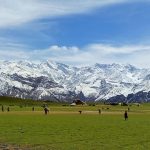
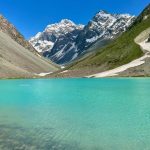
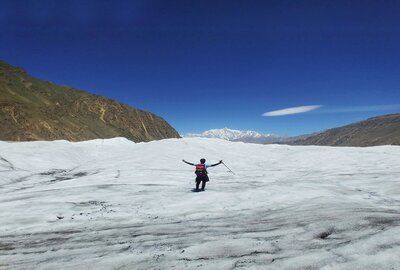
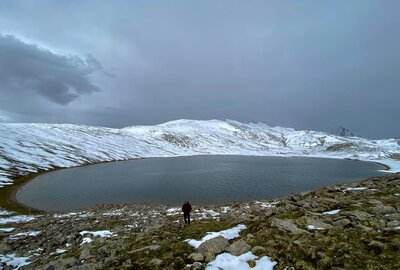
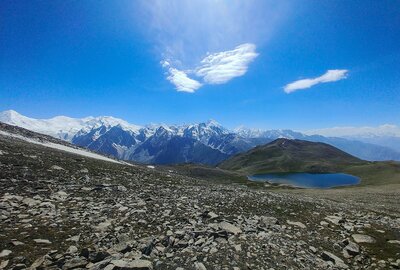
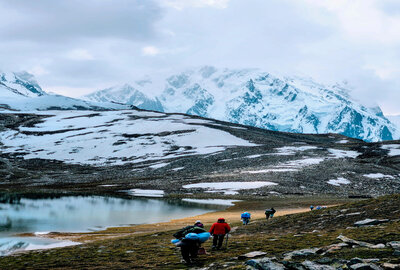
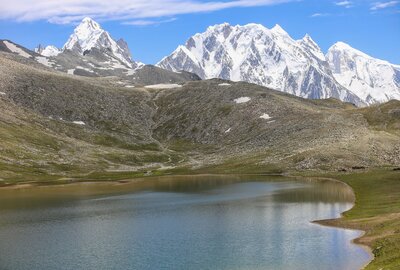
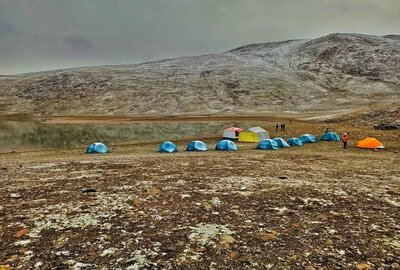
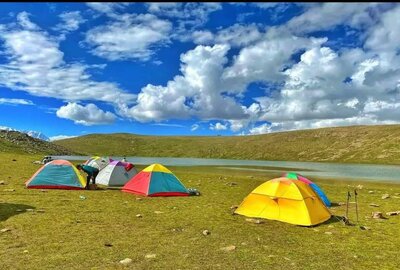
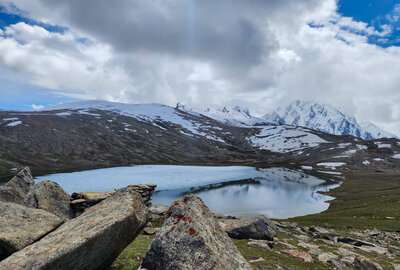
Rush Lake is a high-altitude lake in Nagar Valley, Gilgit-Baltistan, Pakistan, near Rush Pari Peak, 5,098 m (16,726 ft). At 4,694 meters, Rush is one of the highest alpine lakes in the world. It is located about 15 km (9 mi) north of Miar Peak and Spantik (Golden Peak) in the Nagar Valley. Rush Lake and Rush Peak can be reached via Nagar and Hopar, and via the Hopar Glacier (Bualtar Glacier) and Miar Glacier, which rises from the Miar and Phuparash peaks. The trek to Rush Lake provides spectacular views of Spantik, Malubiting, Miar Peak, Phuparash Peak, and Ultar Sar.
Rush Lake is at 4694 meters, looking towards Malubiting Peak to the left and the Miar Peak glacier. While the distinction of being the Highest Lake in Pakistan had always charmed me from an achievement POV, I had also heard about the beauty of this place. But I could never actually put this plan into practice, as it required 8-9 days for a round trip (a sad reality for mountain enthusiasts living in Lahore, South Pakistan).
But a sacrifice never goes to waste. Believe me, this place, not this place, rather this whole trip from Hopar to the Lake and back will overwhelm you. Considering you’ve been on KKH before.
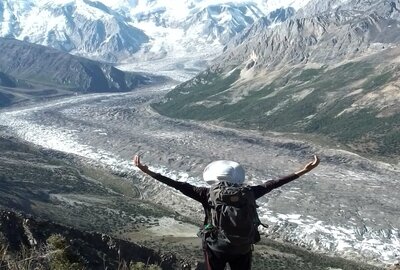
The aura of being surrounded by 7000m peaks, the feeling of actually seeing all those BIG MOUNTAINS that you read about in textbooks, fear/adrenaline induced when crossing the fastest moving glacier of Pakistan, dehydration and fatigue caused by continuous trekking in a dry, hot, and barren land, and chilly cold nights in one of the most silent and serene neighborhoods. All this mixed will surely leave a mark on your mind.
The trek to this Lake starts from Hoper village in Nagar.
Day 1: You have to cross two glaciers (Hoper and Bhurpu) on your way up and camp at Barichokor. It takes 8-10 hours.
Day 2: From there, there is a very, very steep climb of 5-6 hours, and then you walk another hour or so to a campsite, Chedan Haraye. Either you stay there or go directly to the Lake, which is another 1.5-2 hours away.
Day 3: From the Lake, you go down an even steeper and longer track and camp at Phai Pheri. It will take 5-6 hours.
Day 4: Then you cross two more glaciers (Bhurpu and Miar) to reach Hamdar—around 7 hours. You can camp here or go back to Hoper, crossing another glacier(Hoper), which will take another 3 hours.
You can also return the same way you came; however, taking the loop leads you to beautiful meadows and Miar Glacier, which is not to be missed. The best days to go are in mid-July to mid-August. Please check with the locals before leaving.
The days written together like 2/3 and 5/6 can be done in one day. Total days can be 4-6.
The trek starts from Hopper Village, and you descend to Hopper Glacier on day one. Your 1st day will be easy, with a short hike and descent. After 7-8 hours, you will arrive at Bedchikhor, your first Campsite
7-8 Hours Continuous Hike. If you want to do the Lake on the second day, it will be tough for starting-level trekkers, and you will camp by the Lake.
Must Read: Rush Lake Trek
Suggested Read: Beautiful Ansoo Lake Trek
You can submit Rush Peak after Rush Lake, and it will take 3 hours from the Lake. We did a moderate-level hike to Rush Peak, and on the same day, we descended to Pahi Phari and camped alongside the stream.
Must Read: Princess of Lake – Ratti Gali Lake
Must Read: Mesmerizing Karomber Lake Trek
On our 4th day, we decided to reach Hopper Village. It was an easy day because we were descending and walking on the straight trek. Just at the end, crossing the Hopper Glacier and the Hike to Hopper Village was a little tough for starters
Must Read: Trek to Dudipatsar Lake
Suggested Read: Chita Katha Lake Trek
And you can do this last day trek in 7 Hours Max. Keeping Rush Lake in mind, with an elevation of 4700 M and Rush Peak at 5100 M. Most of the trekkers plan to be there in 2 days from Hopper Village. Hopper is at around 2500 M. From Hopper to Rush Lake, one has to climb approximately—2000 M in two days, with the maximum on Day 2.
Rush Lake and Rush Peak are reached via Nagar and the Hopar Valley in Hunza via the Hopar Glacier (Bualtar Glacier) and the Miar Glacier, which rises from Miar and Phuparash peaks. The trek to Rush Lake provides views of Spantik, Malubiting, Miar Peak, Phuparash Peak, and Ultar Sar.
So I haven’t seen any blog posts mentioning acclimatization stages for reaching 4700 M. Is it advisable, and isn’t it risky, to gain 2000 M in 2 days at these elevations, stay the night, and attempt a 5100 M peak the next day? Check the temperature and season before visiting this place.
Must Read: Trek to Saral Lake
Suggested Read: Katora Lake Trek, Kohistan
Rush Lake is a high-altitude lake situated near Rush Pari Peak. The Rush Pari peak is 5,098m high, and Rush Lake is at 4,694m, making it one of the highest lakes in Pakistan. This Lake is situated about 15km north of Miar Peak and Spantik Golden Peak, located in Nagar Valley.
Rush Lake and Rush Peak are both accessible from Nagar and Hoper Valley, as well as via the spectacular Hopper Glacier and Miar Glacier, which rise from Miar Peak and the Phuparash Peaks. These peaks add to the beautiful view on the Rusk Lake tour as you cross and head towards the Lake.
Trek starts from Hopper Valley (2800m)
Stay at the Bari Chakor campsite
Time taken:7hrs
Distance covered:12.45km
Height of Bari Chakor camp site:3215m
Height gain:415m
This day was easy, with two glaciers crossing Hopper Glaciers and Barpo Glaciers,
Bari chakor to chittan harai
Start trekking from Bari Chakor (3215m)
Time taken:6.5hrs
Height reached:4300m
Distance covered:4km
Stay at Chitten Harai campsite
Height gain today:1085m
This day was very strenuous with no water at all.
And you have a sudden height gain of 1100m in just 4km.
Chittan Harai to Rush Lake
Time:2hrs
Distance covered:2km
Height gain:400m
For peak:
Distance covered:4km(loop)
Height gain:800m
Stay at Rush Lake at an altitude of 4700m
This was an easy day up to Rush Lake, but the peak can be difficult.
.
Rush lake to hapakun
Time:8hrs
Hapakun is at a height of:3330m
Distance covered:13km
We have the Miar glacier in between, and it was difficult because of the crevices, and it took a lot of time to cross it
Hapakun to Hopper
Time:3hrs
Distance covered:8km.
Distance and time were short, but the glacier on the way was brutal,
The season just started, so there wasn’t a path on the glacier to cross.
.
The trek is mostly dry, and there are glaciers to cross.
But the views at the end are amazing,
.
This isn’t for beginners and requires good stamina.
Because of altitude gain, one might get sick.
Camping at 4700m can also be tricky and difficult for someone,
Despite its remote location and high-altitude, glacier-filled environment, Rush Lake provides distinctive opportunities for trekkers, photographers, and nature enthusiasts. The following activities are particularly noteworthy:
The Hopar to Rush Lake trek traverses the Hopar and Miar Glaciers, offering views of wildflower meadows and rugged peaks. This moderate-to-strenuous hike offers a rewarding route to the lake.
A short ascent from Rush Lake yields panoramic views of K2, Broad Peak, Gasherbrum IV, and Baintha Brakk on clear days. This activity is suitable for individuals interested in summiting nearby peaks.
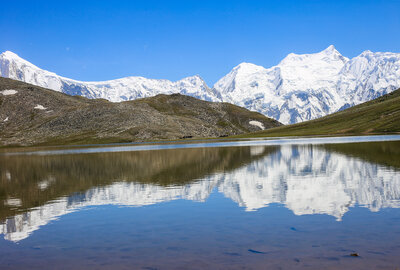
Camping on the grassy shores offers an off-grid overnight experience, allowing visitors to appreciate alpine tranquility and the reflection of surrounding mountains in the lake’s clear waters.
Photographers can document the lake’s turquoise hues set against snow-capped peaks such as Spantik and Ultar Sar. Wildlife observation may include Himalayan ibex, golden eagles, or snow leopards.
At an elevation of 4,694 meters with minimal light pollution, Rush Lake offers exceptional conditions for observing the Milky Way and shooting stars, appealing to night sky enthusiasts.
Campfire gatherings provide opportunities for social interaction, warmth, and simple meals beneath the stars. Nearby alpine meadows, wildflower fields, and streams offer peaceful settings for picnics or meditation amid the Karakoram’s natural beauty.
Guided glacier crossings allow participants to traverse moraines and crevasses, offering both adventure and educational insights into glacial dynamics.
Visitors may engage in basic fishing in the glacial waters or relax along the shore, appreciating the natural sounds of wind and distant avalanches.
Short hikes around Rush Lake provide varied perspectives of Malubiting and Phuparash Peaks.
– Jeep from Gilgit to Hoper: Rs. 20,000 – 25,000
– Guide/Porter (per day): Rs. 10,000 – 15,000
– Tent Stay/Camping: Rs. 5,000 – 8,000 per person
– Meals: Rs. 3,500 – 4,000 per day
– Permit/Entry: Minimal (Rs. 500 – 1,000)
– Total for 4-day trek: Rs. 80,000 – 90,000 per person (group of 4)
Hotels and accommodations are not available beyond Hopper Valley. Please bring suitable camping gear and supplies. For added comfort, accommodations in Nagar and Hunza are available on the Hotels Page.
Tent villages and eco-friendly camps are available at Rush Lake and Phahi Phari. Shared facilities encourage a closer connection with the natural surroundings.
Private lodges in Hoper, including Hoper Inn, offer accommodations at Rs. 3,000 to 5,000 per night.
Family rooms in Nagar, particularly homestays in Karimabad, accommodate groups of four to six at Rs. 5,000 to 8,000.
Nature Adventure Club offers selected hotels in Hunza and assists with bookings and travel arrangements.
– June: 10°C/0°C – Mild days, melting snow, blooming meadows.
– July-August: 15-20°C/5°C – Warmest, ideal for trekking; cold nights.
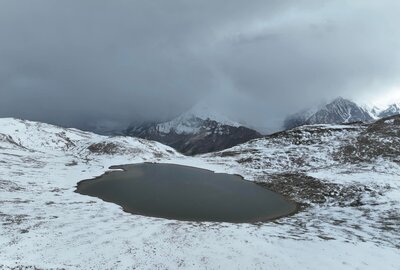
– September: 12°C/2°C – Crisp air, autumn colors; early snow possible.
– October onwards: Below freezing; closed due to snow and avalanches.
Absolutely! Rush Lake is a pristine glacial lake, born from ancient melting ice and cradled by the majestic peaks of the Karakoram range.
Camping under the stars is popular, but booking guides or porters in advance is wise. Make sure you are well-prepared before setting out.
Drone flying is not officially allowed. If you wish to capture aerial views, always ask residents or authorities first, as the terrain is sensitive.
Yes, the area is generally safe, though its remoteness calls for caution. Hiring guides, sticking to marked trails, watching the weather, and honoring local customs will ensure a smooth adventure.
The trek welcomes fit families with adventurous older children. While the route is challenging, cozy homestays in Nagar offer a comfortable place to rest.
Plan your visit between June and September, when the trails open up, and the weather is at its friendliest.
Yes, Rush Lake welcomes all visitors, but a good level of fitness is essential for the trek.
A: Required documents include a CNIC or passport, a possible trekking permit from Gilgit, confirmation of guide booking, and access to a 4×4 vehicle.
The Rush Lake Trek usually spans three days, offering a rewarding mix of moderate hiking and breathtaking scenery.
Most trekkers complete the journey in about three days.
The Rush Lake Trek is moderately challenging, but spreading it over three days makes the adventure much more enjoyable.
No, you will need a professional guide and porter to experience this trek safely.
WhatsApp us