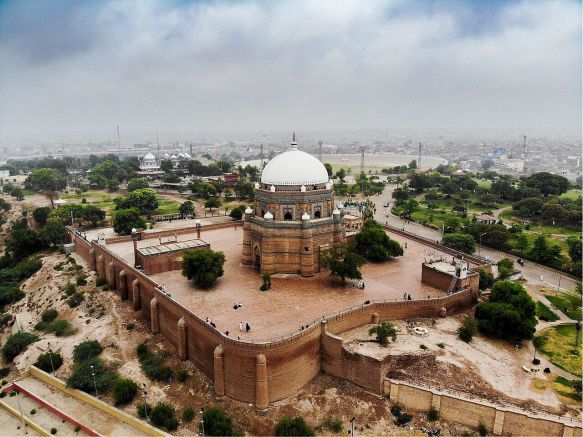

The 13th-century Shrine of Bahauddin Zakariya is the resting place of the eponymous Sufi mystic. Bahauddin Zakariya introduced the Suhrawardiyya order from Baghdad to South Asia, becoming one of the region’s most influential spiritual leaders. Today, the shrine stands as one of Multan’s most iconic attractions, drawing a steady stream of pilgrims daily. Its distinctive red bricks and blue tiles epitomize the architectural style of the region, marking it as one of the earliest examples of Multani design.
Originally hailing from Afghanistan, the Islamic Sufi saint Shah Yusuf Gardezi arrived in Multan in 1088. He was instrumental in spreading Twelver Shi’ism in the area, and many miracles are attributed to him during his lifetime. Constructed in 1152, Gardezi’s shrine captivates visitors with its stunning exterior, adorned with the region’s characteristic blue glazed tiles. The serene atmosphere surrounding the complex invites peaceful reflection.
The shrine in Multan exudes a quiet sophistication, creating an ideal environment for meditation. Visitors often find the atmosphere calming and relaxed, fostering a deep sense of tranquility. With a rich history spanning over 1,000 years, this shrine is a must-visit for anyone traveling to the area. While you are there, be sure to take a moment to feed the pigeons that flock around the shrine, enhancing the serene experience.
Commissioned by Sultan Ghiasuddin Tughlaq between 1320 and 1324 AD, the tomb’s rich historical significance is enhanced by the sight of pigeons that gracefully inhabit the site, adding to its authentic charm. Remember that visitors are required to remove their shoes before entering, making for a respectful and immersive visit. The Tomb of Shah Rukn-e-Alam in Multan, Pakistan, is a 14th-century Sufi shrine inscribed on the UNESCO World Heritage List.
This shrine is dedicated to the Sufi saint Hazrat Shah Rukn-e-Alam, who was the son of Pir Sadar-Al-Din Arif. He was born in Multan on Friday, the 9th of Ramadan in 649 Hijri (November 26, 1251). Shah Rukn-e-Alam was the grandson and successor of Sheikh Baha-ud-Din Zakariya.
You can spend some time exploring the area and capturing beautiful pictures of the stunning dome and intricate designs. The peaceful environment added to the charm, making it a perfect spot to relax and reflect. The tomb is octagonal in shape, featuring a large hall where visitors can see the grave of the Sufi saint buried there. The dome has a diameter of around 15 meters and stands 35 meters high.
Visiting the Tomb of Shah Rukn-e-Alam is a captivating experience, offering a delightful mix of history, stunning photography opportunities, and delicious cuisine. Nestled in Multan, this remarkable structure, built nearly 800 years ago from red brick and supported by shisham wood beams, is regarded as the finest building in the area.
On the northern outskirts of Multan lies the Shahi Eid Gah Mosque, an exquisite example of late-Mughal architecture constructed during the reign of Emperor Muhammad Shah (1719-48). This mosque, financed by Nawab Abdul Samad Khan, the Mughal governor of Multan, showcases his piety and effective governance.
The mosque has a north-south orientation, slightly angled southwest to ensure its qibla wall aligns perpendicularly to Mecca. It consists of seven domed chambers arranged symmetrically in a long row, measuring 76 by 16 meters.
An expansive courtyard located to the east of the mosque provides space for gatherings, with entrances on the north, east, and south. Historically, the Shahi Eid Gah serves as an Eidgah, a mosque designated for Eid prayers, allowing the community to come together on significant holidays like Eid al-Fitr and Eid al-Adha.
Fort Kohna, also known as Multan Fort or the Old Fort, has a rich history dating back approximately 2600 years. Built on a high mound in the heart of Multan, overlooking the River Chanab (and Ravi), its purpose was to defend the city against invaders from the west and north.
Throughout the centuries, the fort endured multiple destructions and reconstructions, with the last iteration completed around 1100 years ago. This semi-circular fortress featured a 7000-foot-long wall, 46 bastions, and four prominent gates: Khizri, Hareiri, Sikki, and Qasim.
A deep ditch, 25 feet deep and 40 feet wide, further fortified its defenses. The fort faced destruction at the hands of Ranjeet Singh’s forces in 1818 and was eventually demolished by British bombardment in 1848-49. Despite its ruin, the site remains a beloved destination for visitors from around the world.
Originally built in 1329, Shah Shams Sabzwari’s tomb underwent significant reconstruction after a fire in the 18th century. This mausoleum holds the remains of the Sufi saint known for spreading Isma’ili Islam throughout South Asia. The tomb showcases a unique architectural design with a square ground floor, an octagonal second floor, and a circular third floor—all hallmarks of Multani tomb architecture.
Shamsuddin Sabzwari arrived in Multan in the early 1200s C.E., in what is now modern Pakistan. He established a dargah and preached Islam to the local population. Shamsuddin Sabzwari is revered as a saint due to his poetry and the local traditions surrounding him. He passed away in 1276, and his mausoleum is in Multan. The Urs of Shamsuddin Sabzwari is celebrated every June.
For those who appreciate ancient and pre-Mughal architecture, this mausoleum is a must-see. It is dedicated to Shah Shams Sabzwari, a prominent Muslim saint who was born in 1165 and died in 1276. The tomb was constructed by his grandson in 1330. When visiting the mausoleum, please remember to show respect and adhere to Muslim customs. This site is rich in history, which you will discover during your visit.
Nearby, there is a large park known as Shah Shams Park, which features slides, rides, boating, and other entertainment options for both children and adults. Various cafes and snack shops offer local food, tea, and cold drinks.
Insider Tip: If you are traveling to Multan during the summer season (from May to August), it is best to visit these sites in the evening, as temperatures can be extremely high during the day. And don’t forget to bring your camera!
Situated in the bustling heart of Multan, the Ghanta Ghar Clock Tower was constructed by the British in the late 19th century. Its design is reminiscent of structures like the Gateway to India in Mumbai and the Victoria Memorial in Kolkata. Visitors can enter the building and climb its stairs to the rooftop, where a breathtaking view of Multan’s lively streets awaits.
Built in the style of Big Ben by the British, the Ghanta Ghar, meaning “hour house,” is adorned with bright red bricks, making it a striking visual highlight and a popular spot for photographs. As a hub for different vendors and civil government offices, it remains a must-visit attraction in Multan.
For those eager to delve into Multan’s rich history, the Multan Museum is a must-visit. It boasts a collection of historical artifacts, documents, and artworks spanning various periods. Housed within the Damdama building, which once served as a watchtower and gunnery, the museum’s rooftop offers a nice vantage point of the city.
Another notable site in Multan is the Multan Museum, which boasts a rich collection of artifacts that reflect the region’s historical and cultural heritage. It features archaeological finds, historical documents, and artworks from various periods, serving as an educational resource that provides insights into the evolution of the area.
One of the city’s historical landmarks is the Delhi Gate, originally constructed in the 17th century under the orders of Prince Murad Bakhsh. It underwent significant repairs and reconstruction in 1756 by Muhammad Ali Khan Khakwani. Historically, the area inside the gate was the opulent palaces and gardens of Nawab Saeed Khan Qureshi, whose tomb now stands there.
The gate faced destruction during an attack by the British army on December 29, 1848. After the British Raj was established and peace restored, the gate was reconstructed, this time serving as a memorial to the conflicts that occurred in 1848 rather than as a defensive structure.
Multan is celebrated for its exquisite blue pottery, making it an excellent spot for picking up unique Pakistani souvenirs. This art form was introduced to the area centuries ago, drawing inspiration from Persian, Central Asian, and Mongolian styles.
The process of creating Multani Blue Pottery is an intricate art form that blends traditional craftsmanship with modern aesthetics. Each piece showcases vibrant blue tones and requires meticulous handcrafting from casting to finishing, emphasizing the skill and dedication of the artisans involved.
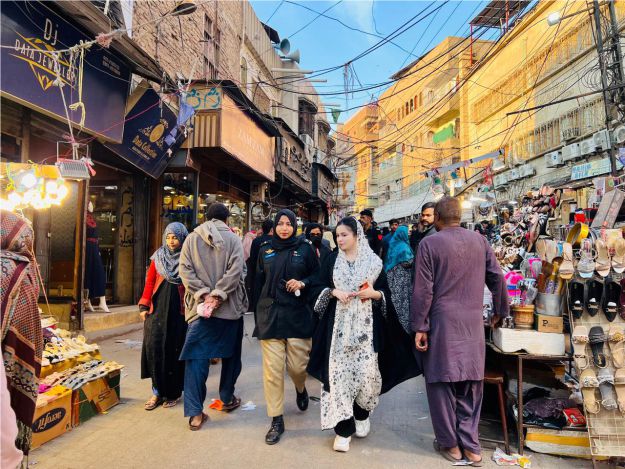
Immerse yourself in the vibrant atmosphere of Hussain Agahi Bazaar, a feast for the senses filled with a riot of colors, enticing aromas, and lively sounds. This market is the go-to spot for beautiful Multani pottery, traditional ajrak, and exquisite camel skin lamps.
Discover the scenic outskirts of Multan by taking a camel ride, a truly unique experience that connects you with the local lifestyle and offers a glimpse into the region’s culture.
Unwind and enjoy the serene beauty of the Chenab River with a leisurely cruise, particularly breathtaking during sunset when the landscape comes alive with warm hues.
Dive into Multan’s culinary scene, which is as rich as its history. Do not miss out on these local specialties:
Multan boasts a wide range of accommodations to suit every taste and budget:
For local transport, you will find rickshaws, buses, and app-based ride services like Careem to get around easily.
The city’s friendly locals often add to the positive experience, welcoming you with their renowned hospitality.